
Read this if…
You work in B2B marketing or growth and you’re thinking things like:
- “Our organic traffic is tanking.”
- “Everyone’s using ChatGPT now, do blogs even matter?”
- “How do I get my brand into AI answers, not just Google results?”
In this blog, I will take you through:
- How the B2B buyer journey has changed because of AI.
- What types of content to focus on at each funnel stage now.
- How to make your content easier for LLMs like ChatGPT and Perplexity to “pick up.”
- A simple 90‑day plan to update your content strategy without burning out.
Welcome to the AI + SEO Plot Twist
Content is easier to create than ever. You can ask an LLM to write a 1,500‑word blog in 10 seconds. That sounds great… until you realize everyone else is doing the exact same thing.
We’re now in a world where:
- Google is rolling out AI Overviews.
- People start their research on ChatGPT instead of search.
- Forums, UGC, and niche sites get rewarded as “hidden gems” in search and AI results.
At the same time, big players are getting hit hard. HubSpot’s traffic drop sparked a whole industry debate, with several analyses showing their blog lost around 60–70% of its SEO traffic, especially on broad, top‑of‑funnel keywords. In line with Ahrefs’s study that found, Al overviews reduces CTR by 58%.
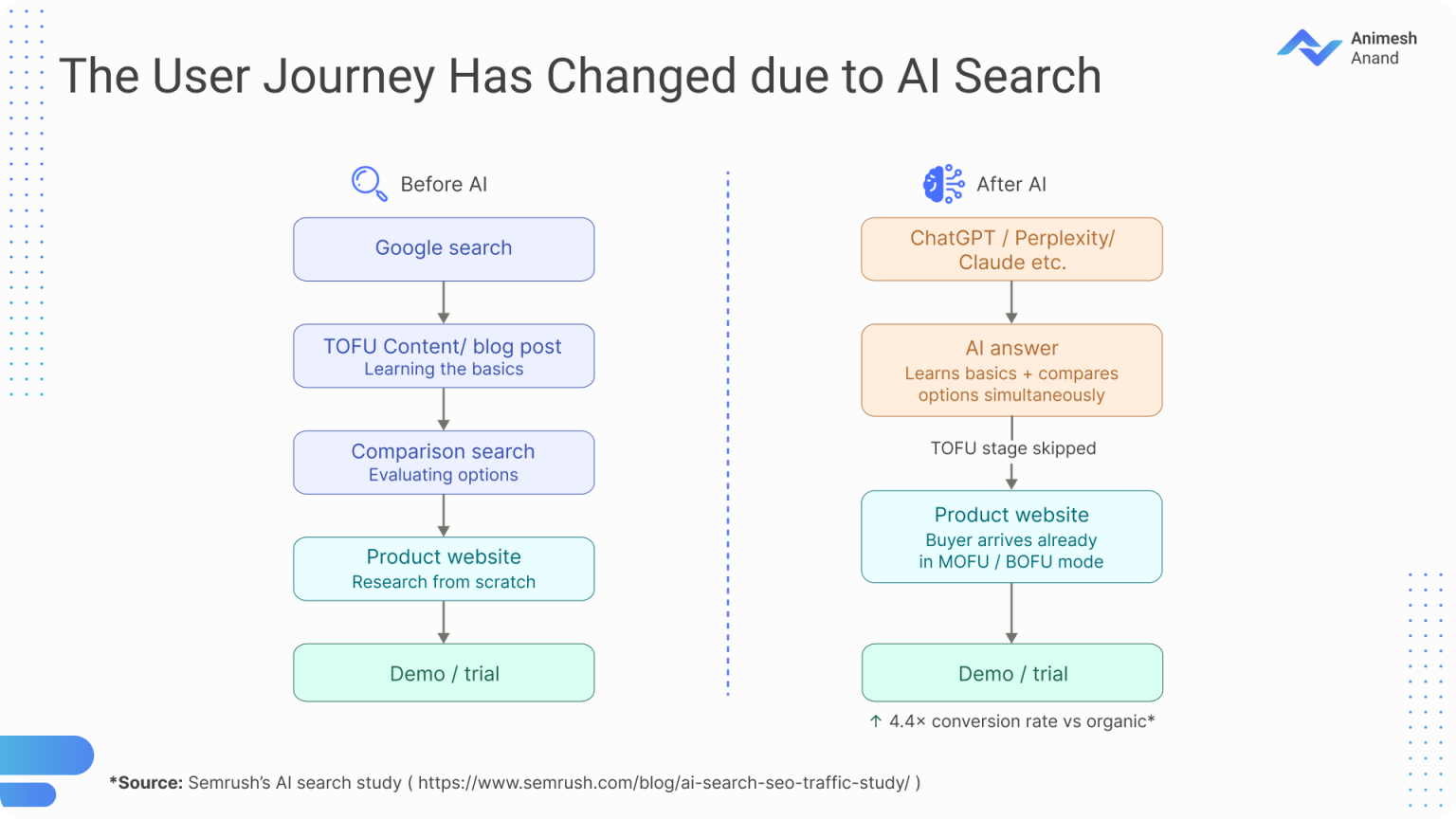
Meanwhile, Semrush’s AI search study shows something wild: visitors coming from AI search experiences (like LLM recommendations) can convert at roughly 4.4x the rate of traditional organic visitors. So yes, traffic might go down—but the value per visit can go way up.
The game hasn’t ended. It just changed rules.
Why Content Still Matters (Even If Traffic Drops)
If you strip away the buzzwords, content still does three jobs in B2B:
- It explains the problem.
- It explains your solution.
- It builds enough trust for someone to take the next step.
CMOs know this. In recent surveys, most say content creation is still a top priority going into 2026 because paid alone isn’t enough and organic is still the only scalable, compounding growth channel.
The difference now is:
- Content is less about “How do I rank for this keyword?”
- And more about “How do I become the most useful and quotable answer—whether a human or an AI is reading?”
So yes, content is very much alive. But “10 AI tools for marketers” written by a bot won’t cut it anymore.
How AI Changed the B2B Buyer Journey
Let’s be honest: most buyers don’t type “What is [category]?” into Google now. They open ChatGPT and ask:
“What are the best B2B marketing automation tools for mid‑market SaaS?”
By the time they land on your website, most of the basic research is already done. Semrush’s AI search findings back this up—AI‑referred visitors show much higher intent and conversion rates because the “education phase” often happened inside the AI tool.
What this means in practice:
- You get fewer pure TOFU visitors.
- You get more people in MOFU/BOFU mode: “I know I need something. Is your product the right one?”
- Your website’s job shifts from “teach me the basics” to “prove you’re the best fit.”
So your content mix has to move with that. Not all TOFU is dead, but generic “what is…” posts absolutely are.
The New Content Mix: TOFU, MOFU, BOFU
Let’s make it super practical. What should be the mix of content you should have in your portfolio for maximum performance.
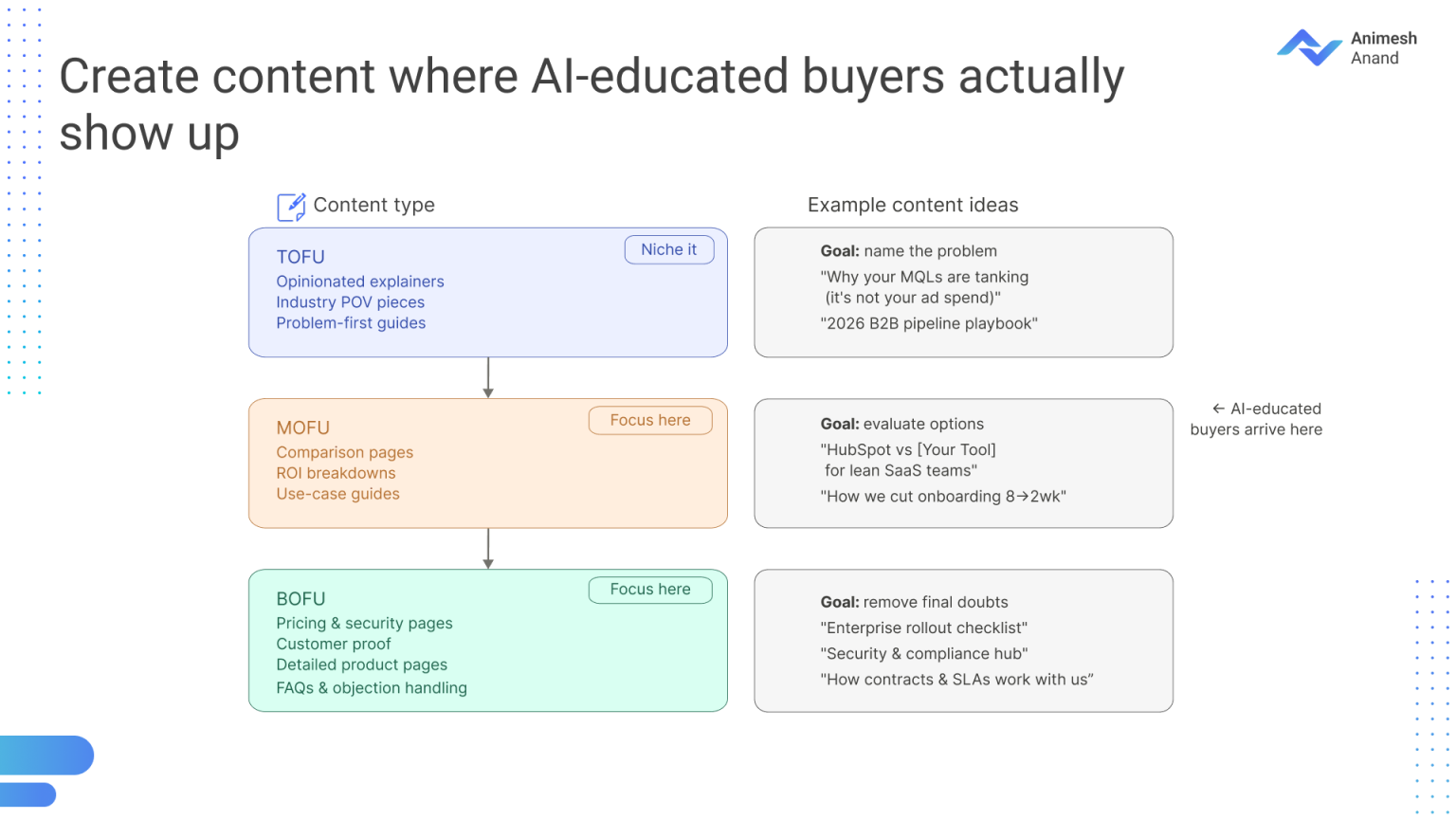
Focus your net-new content efforts on MOFU and BOFU first, because that’s where AI‑educated buyers show up. Keep TOFU, but make it opinionated, niche, and problem‑first, not generic definitions AI already does better.
How to Make Your Content “LLM-Friendly”.(What’s working right now)
Now the fun part: how do you actually get mentioned by ChatGPT, Perplexity, and co.?
LLMs look for content that is:
- Clear and easy to quote.
- Specific, not fluffy.
- Backed by real experience and outcomes (hello E‑E‑A‑T).
Here’s a simple checklist for LLM‑friendly pages:
- Write direct, answer‑like sections
- Use headings like “Who is this for?”, “How it works”, “Pros and cons”, “Alternatives” so an AI can easily lift a section.
- Add comparison pages
- Yes, mentioning competitors by name is scary, but AI tools love comparison content because that’s what users ask for.
- Include natural‑language FAQs
- Use real questions people type or speak: “Is [Your Tool] better than [Competitor] for small teams?”
- Show real experience
- Add case study metrics, quotes, screenshots, and named customers where possible. This is how you prove the “Experience” and “Expertise” in E‑E‑A‑T.
- Strip out fake marketing speak
- Replace “synergistic, cutting‑edge, world‑class platform” with “a marketing automation tool for B2B SaaS teams with under 50 sellers.”
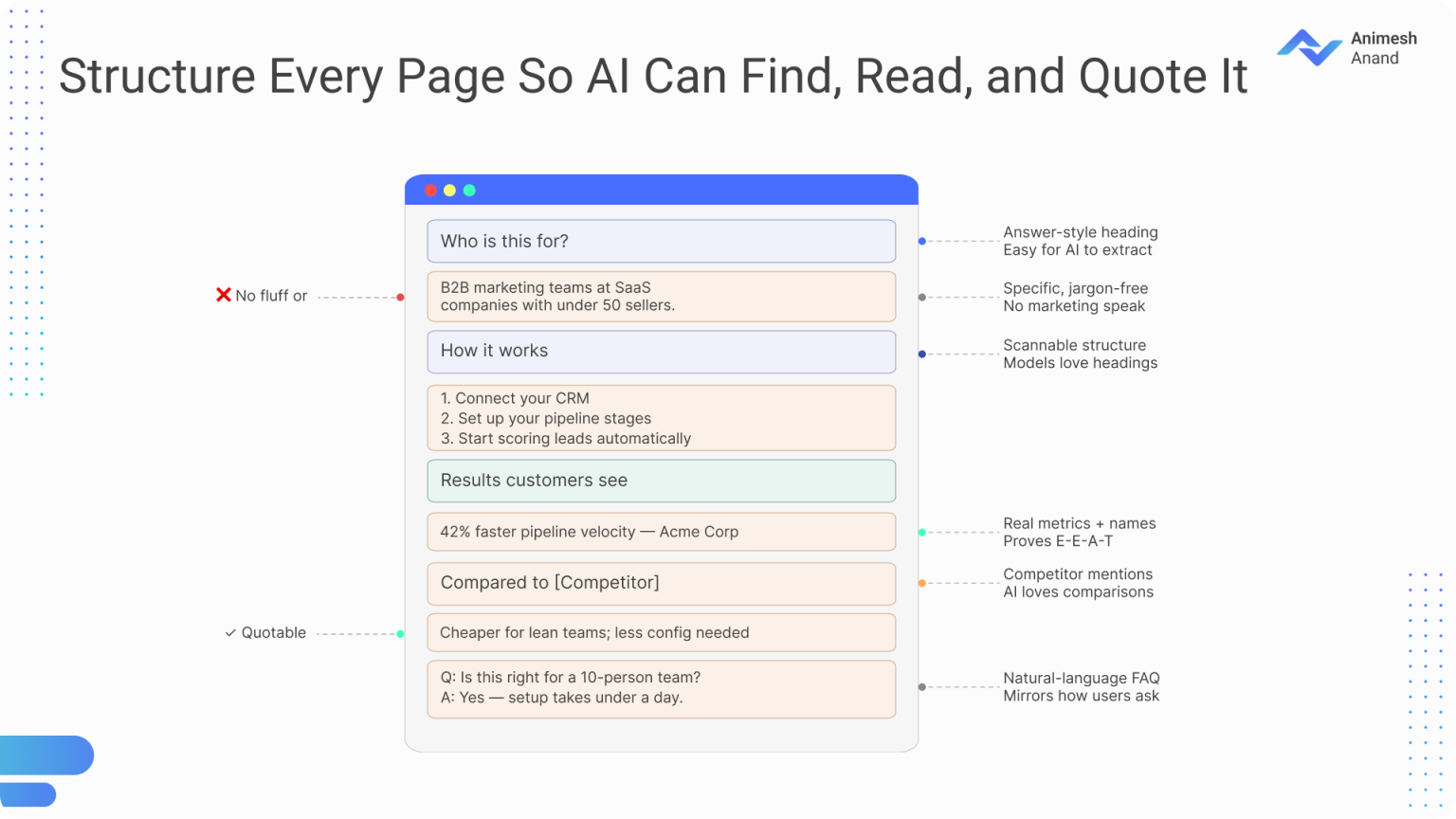
If an AI model can easily turn your page into a clean 2–3 sentence summary, you’re on the right track.
Brand Authority vs Popularity: Where to Show Up
Here’s the paradox:- AI tools talk a lot about “trust”, “authoritative sources”, and E‑E‑A‑T.
- But they still often cite Reddit threads, G2 reviews, and community blogs.
Quick framework
- If your domain is young or low‑authority:
- Go harder on third‑party presence (G2/Capterra/Reddit/guest posts) to “borrow” trust.
- Build 2–3 deep, flagship pieces on your own site that you keep refreshing.
- If your domain is strong but you lack social proof:
- Get systematic about reviews and case studies on G2, Capterra, and industry directories.
- Join discussions on Reddit, Slack communities, or niche forums.
Practical moves
- G2 / Capterra
- Set a quarterly target for new reviews.
- Reuse review quotes on your site and in product pages.
- Reddit / communities
- Don’t shill. Answer questions in depth, share frameworks, and only plug your product when it’s genuinely relevant.
- YouTube
- Demo videos, teardown videos, and “here’s how we actually do X” content are all strong E‑E‑A‑T signals and great sources for AI and human research.
What to Gate (and What to Give Away)
Gating everything is a terrible idea in an AI‑first world. If users can’t see your value, they’ll just ask an LLM for alternatives and never bother with your form. Ungate:- Product capabilities and USPs.
- High‑level case studies and outcomes.
- Core “how this works” and “is this right for me?” pages.
- Calculators (ROI, pricing, forecasting).
- Deep benchmark reports or original research.
- Detailed templates, toolkits, or playbooks.
The Technical & Structural Basics (That Still Matter)
Even in an AI world, technical SEO and content structure aren’t dead; they just shifted from “rank only” to “readability and extractability.” Make sure your site:- Loads fast and works well on mobile.
- Uses clear headings and short paragraphs, so both humans and models can scan it.
- Implements structured data where it makes sense: FAQ, HowTo, Product, Organization schema are all useful signals.
- Organizes content into topic clusters (one pillar page + several focused supporting posts).
- Gets refreshed regularly—especially pages that AI tools might rely on for “facts” like pricing, features, or legal info.
A Simple 90‑Day Action Plan
Here’s a realistic plan you could follow without having a 10‑person content team.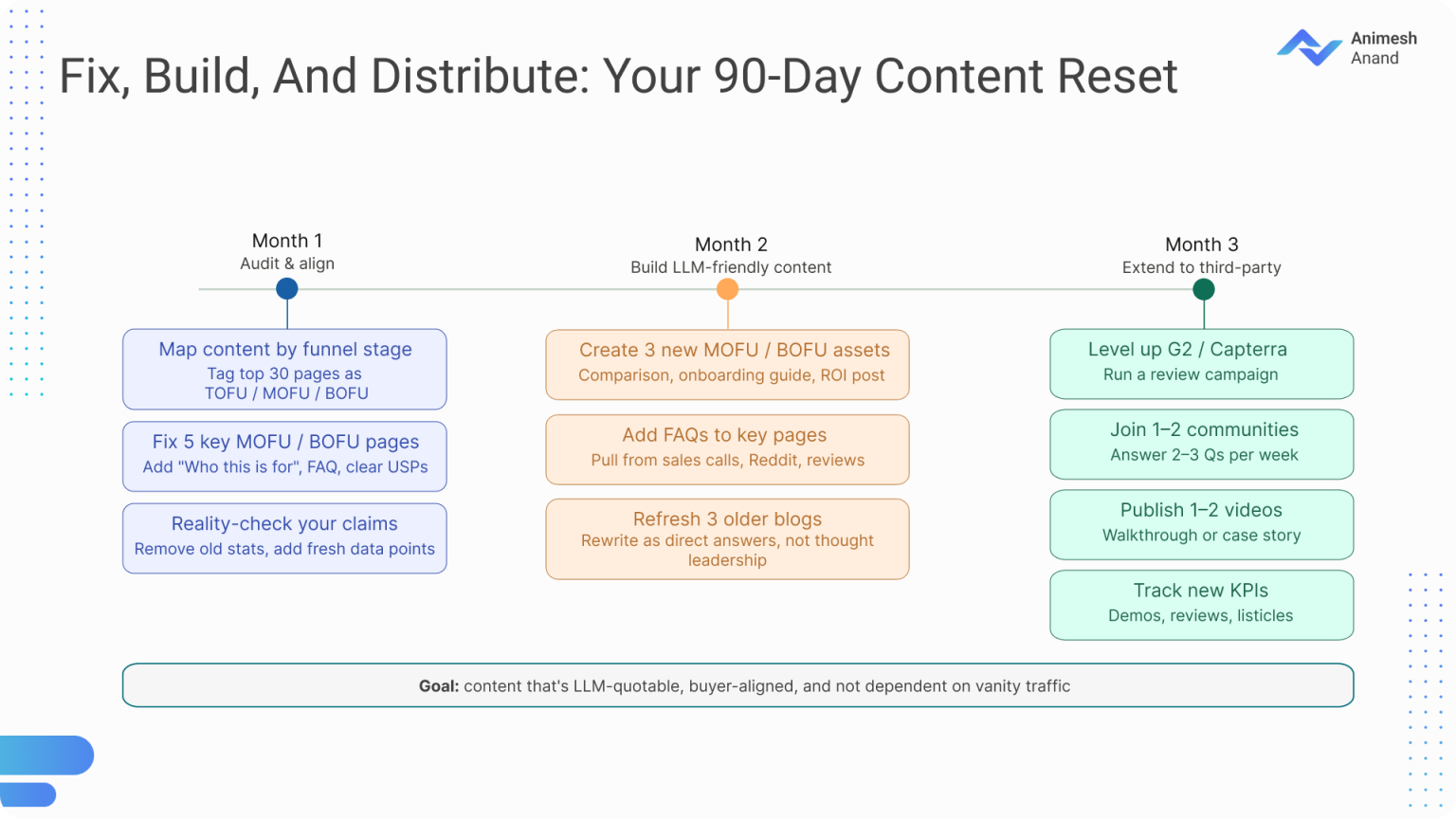
Month 1: Audit and Align
- Map your current content by funnel stage
- Tag your top 30 pages as TOFU, MOFU, or BOFU.
- Highlight which ones actually tie to your product vs random “SEO bait.”
- Fix your 5 most important BOFU/MOFU pages
- Add clear “Who this is for”, “How it works”, “Key benefits”, and an FAQ section.
- Make sure your product capabilities and USPs are fully visible (not gated).
- Reality‑check your claims
- Remove outdated stats, add 1–2 fresh, sourced data points where relevant.
Month 2: Build LLM‑Friendly Content
- Create 3 new MOFU/BOFU assets
- 1 comparison page (You vs Competitor or You vs Status Quo).
- 1 implementation or onboarding guide.
- 1 ROI or “business case” article.
- Add natural‑language FAQs to key pages
- Pull questions from sales calls, support tickets, Reddit, and review sites.
- Refresh 3 older blogs
- Rewrite them so they read like direct answers instead of vague thought leadership.
Month 3: Extend to Third‑Party Platforms
- Launch or level‑up your G2 / Capterra presence
- Run a small review campaign with existing customers.
- Join 1–2 relevant communities
- Commit to answering at least 2–3 questions per week in a helpful, non‑spammy way.
- Publish 1–2 video pieces
- A simple loom‑style walkthrough, a “here’s how we actually do X” tutorial, or a short case story is enough.
- Start tracking new KPIs
- Not just traffic, but: demo requests from content, assisted conversions, review volume, and appearance in listicles/roundups.
If you do this consistently for 90 days, your content will be:
- Easier for AI to understand and quote.
- More aligned with how buyers actually research now.
- Less dependent on vanity traffic.
So, Is This Really an “SEO Apocalypse”?
Kind of—but not in the “nothing works anymore” way. It’s more like this:
- Basic, generic SEO content is dying.
- Helpful, focused, experience‑backed content is getting more valuable.
Search is turning into “answer discovery,” and AI tools are part of that ecosystem now. The brands that win aren’t the ones that publish the most blogs—they’re the ones that:
- Understand their buyers deeply.
- Show real proof, not just claims.
- Show up in the places humans and models both go to learn.
You don’t need to scrap everything and start over. You just need to update your playbook for a world where your next best customer might meet you through a chatbot before they ever see your homepage.
Liked reading this article?
Let’s connect and explore opportunities of working together.