What You’ll Need Before Starting (Prerequisites)
Keeping this part short on purpose, it’s genuinely not a long list:
- Docker Desktop installed. Grab it here. Free for personal use.
- A DataforSEO account. Register here. It is free, no credit card required, and you get $1 in free credit right out of the gate.
- About 15–20 minutes.
- Optional: a Google account, if you want to hook up Google Search Console later.
- Zero coding knowledge required. If you can copy a command, paste it into a terminal, and click a button, you can absolutely do this.
That’s it. No dev environment, no config files you need to understand line by line.
Step 1: Setting Up Your DataforSEO Account and API Key
First things first: you need your API credentials, since this is what actually gives OpenSEO permission to pull data on your behalf.
- Go to dataforseo.com and register an account.
- Once you’re in, head to the API Access section in your dashboard.
- Click “Send by email” (sometimes labeled “Send by email”) to get your credentials.
- You’ll get back a login and an API password, think of these as your username and password specifically for API calls, separate from your regular login.

- Now here’s the one slightly technical bit: you need to combine your login and password into a Base64-encoded string. Don’t overthink this, it’s just your login and password mashed together in a format the system reads correctly. To do this, justy run
printf '%s' 'username:password' | base64
- Save that encoded key somewhere safe. You’re going to paste it into OpenSEO in the next step.
- On credits: your account starts with $1 free, which is honestly enough to cover hundreds of keyword lookups just to get a feel for things. When you want more, the minimum top-up is $50.
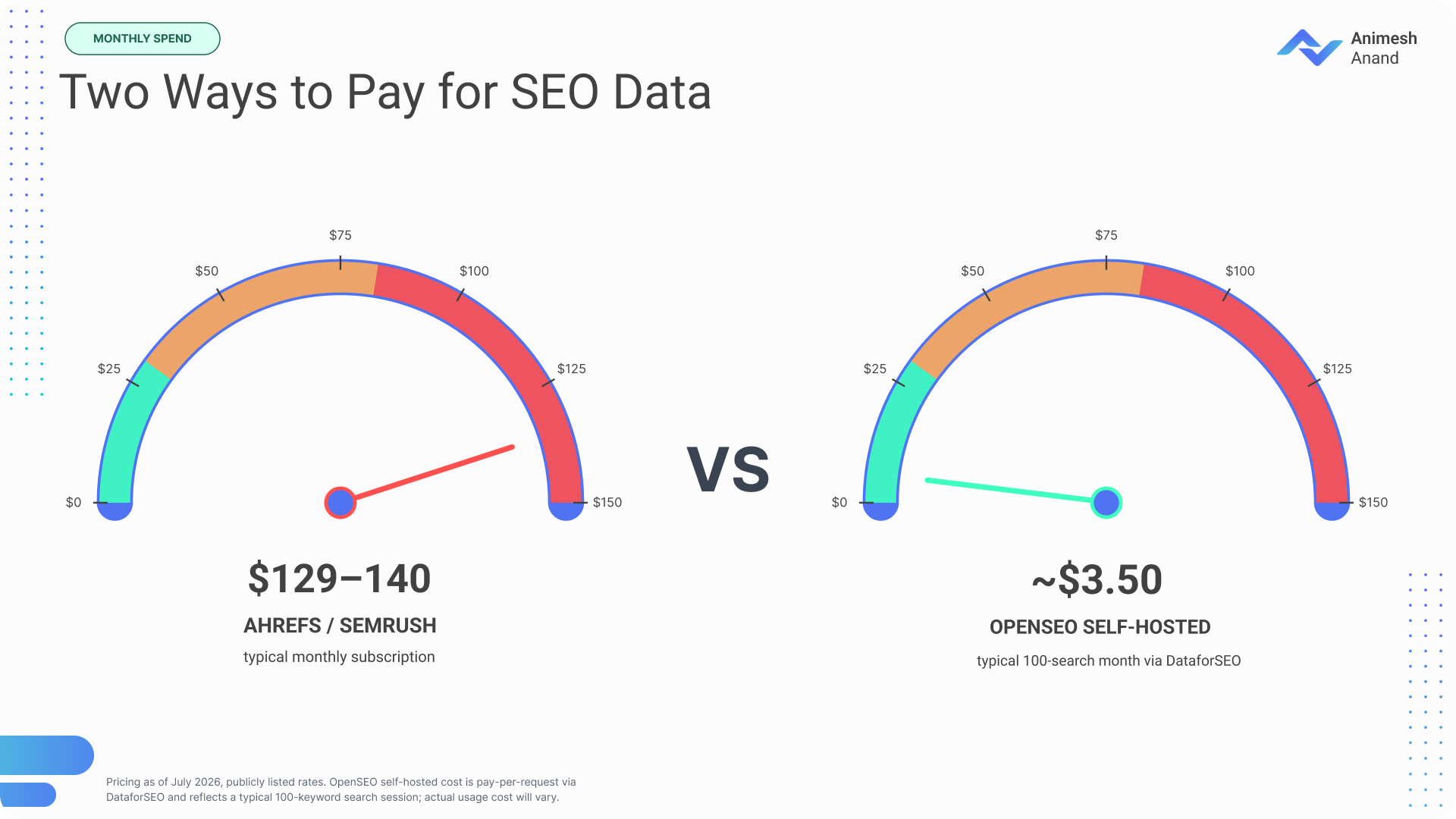
Quick reality check on pricing while we’re here: standard requests run about $0.0006 each, meaning a $50 deposit covers something like 80,000+ SERP queries. Compare that to a single month of Ahrefs and it’s not even close.
Step 2: Installing OpenSEO on Your Local Machine
This is the part where non-technical folks usually get nervous, so let me be extra clear: you don’t need to understand what these commands do. Just copy them exactly as written and paste them into your terminal.
- Open Docker Desktop and make sure it’s actually running, you’ll see a little whale icon in your taskbar or menu bar.
- Open your Terminal (Mac/Linux) or Command Prompt / PowerShell (Windows).
- Clone the OpenSEO repository:
git clone https://github.com/every-app/open-seo.git
cd open-seo
In plain English: this downloads OpenSEO’s code onto your computer and moves you into that folder so the next commands actually work.
- Set up your environment file: Copy the example .env file, find the line that says DATAFORSEO_API_KEY,
and paste in the Base64-encoded key you saved back in Step 1.Start OpenSEO.
Don’t forget to remove the “#” symbol at the begining of the line.docker compose up
Plain English again: this tells Docker to build and launch OpenSEO. The first time you run it, it’ll download some files in the background. This can take a few minutes. Once your terminal shows it’s ready, move on.
- Open your browser and go to localhost (or whatever specific URL the terminal shows you).
- You should now be looking at the OpenSEO dashboard.
If something goes sideways:
- Docker won’t start? Double-check Docker Desktop is actually open and running.
- Port conflict error? Something else on your machine is using that port then close it, or change the port inside your .env file.
- Still stuck? The OpenSEO Discord community is active and genuinely helpful.
One more thing worth knowing: by default, the Docker setup runs with AUTH_MODE=local_noauth, meaning there’s no login screen at all. The tool only lives on your computer, which is totally fine for personal use. If you eventually need multiple people accessing it, that’s when you’d look at the Cloudflare deployment instead.
Step 3: Your First Keyword Research in OpenSEO
Okay, this is the moment that makes the whole setup click.
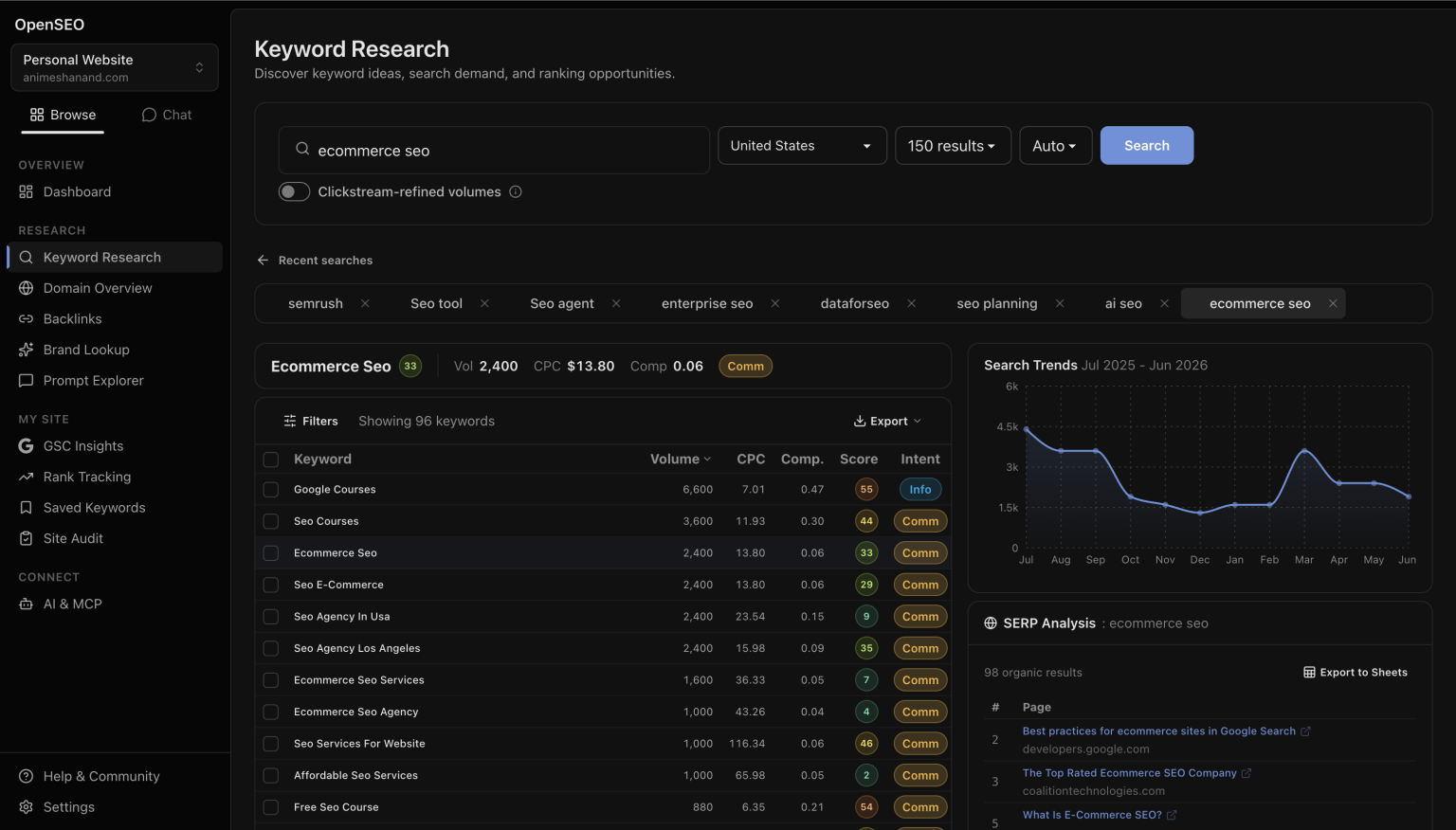
- Click “Keyword Research” in the sidebar.
- Type in a seed keyword, whatever’s relevant to your niche or your client’s site.
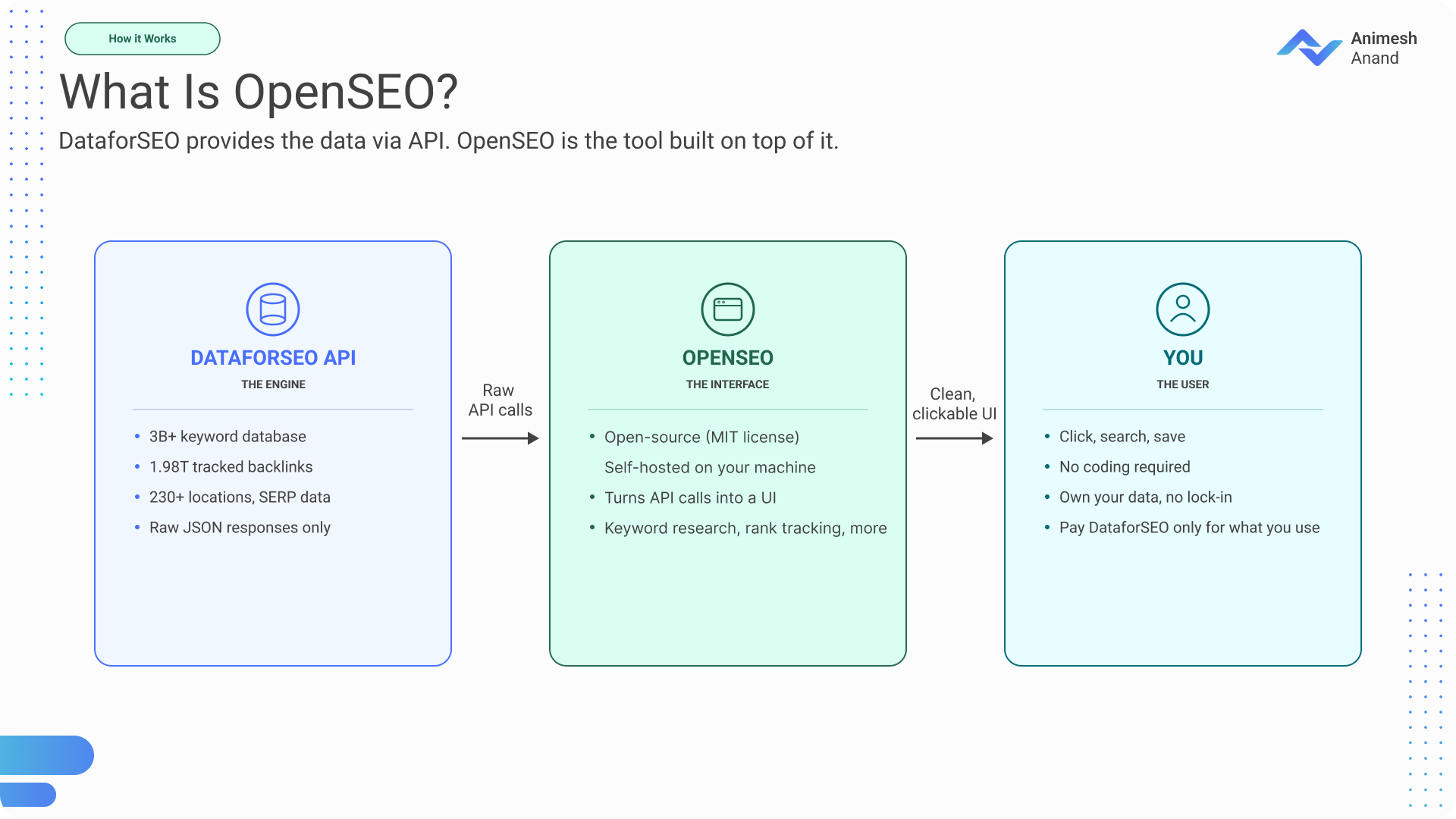
- OpenSEO calls DataforSEO’s API behind the scenes, and results show up in a matter of seconds.
- You’ll see keyword ideas complete with search volume, keyword difficulty (KD), CPC, and search intent signals.
- You can inspect live SERPs right next to the keyword data, so you can actually see what’s ranking right now for each term.
- Save the promising ones to your workspace, tag them however you like, content planning, rank tracking, clustering, whatever your workflow needs.